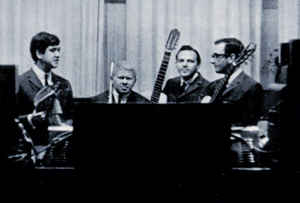
The Quarteto Novo was a pioneering group that had a strong Northeastern accent. The Quarteto Novo brought together the traditions of the region of Brazil with the bebop music language. This result was so powerful that it helped to break cultural and physical boundaries around the world. You can find baiao grooves, including those in “Save the Last Dance for Me” (The Drifters), “Hound Dog” (Elvis Presley), “She Loves You” by the Beatles, and “Do You know the Way to San Jose?” by Burt Bacharach. There are also many jazz versions that use this rhythm. Egberto Gismonti is one of the most prominent and modern proponents this genre. In 1966, the Rhodia company wanted live music for a fashion event, hiring the violonista/guitarist/banjo player/viola player Heraldo do Monte, drummer/percussionist Airto Moreira, and bassist/violonista Theo de Barros and forming the Trio Novo. The Trio was asked to accompany Jair Rodrigues when Geraldo Vandre’s “Disparada”, a composition by Geraldo Vandre, was classified on TV Record’s II Festival of Brazilian Popular Music. The contract with Rhodia meant that they couldn’t perform at the festival. However, the Trio Novo effectively supported Jair Rodrigues at the festival under a different arrangement: Edgar Giannullo on violao, Manini on drums and Aires on Brazilian viola. The trio was renamed the Quarteto Novo after Hermeto Pascoal, a pianist and brass/flute player, joined it. In 1967, Odeon released its first LP, the Quarteto Novo. Quarteto Novo was awarded the Trofeu Imprensa and Trofeu Roquette pinto. Geraldo Vandre sponsored the Quarteto Novo and he had a good salary as an inspection for SUNAB (a government agency). Vandre’s only group, they toured Brazil with them as the backing band for Vandre’s 1968 album Canto Geral. Vandre was also accompanied by the group on a number of TV Shows for TV Record and TV Bandeirantes in Sao Paulo. Edu Lobo, Marilia Medalha and Vandre were also supported by the group at TV Record’s III Festival of Brazilian Popular Music. Edu recorded the song with the Quarteto Novo as accompaniment. The group also accompanied Edu during his European tour. The group broke up in 1969. The LP was reissued in 1993 by EMI/Odeon and released as a CD.